Tag: EBC

  • Reasons for Choosing Kongde Instead of Everest Base Camp

    Reasons for Choosing Kongde Instead of Everest Base Camp

    Reasons for Choosing Kongde Instead of the Classic Everest Base Camp Trek

    For most people, when one doctor refers to the trek in Nepal the full on and famous Everest Base Camp (EBC) trek. With good reason, the trek to Everest Base Camp was featured in the movie, “The Summit,” and provides great scenery and takes you to the base of the highest mountain on the planet. 

    Enter the Kongde Route

    Most people would call the Kongde trek the “hidden gem” of the Khumbu region. The Kongde trek is lower in altitude than EBC, quieter than EBC. It has more views than EBC, and provides a more luxurious experience than EBC. The Kongde trek as the name suggests is a stunning and spectacular trek for trekkers looking for an alternative to Everest Base Camp with great Himalayan scenery and culture. It is simply a beautiful trek if you are looking for an alternative trek to Everest Base Camp with a different view of the majestic Himalayan scenery and culture. Real elevation exhaustion and far too many fellow trekkers is part of the classic trek at Everest Base Camp.
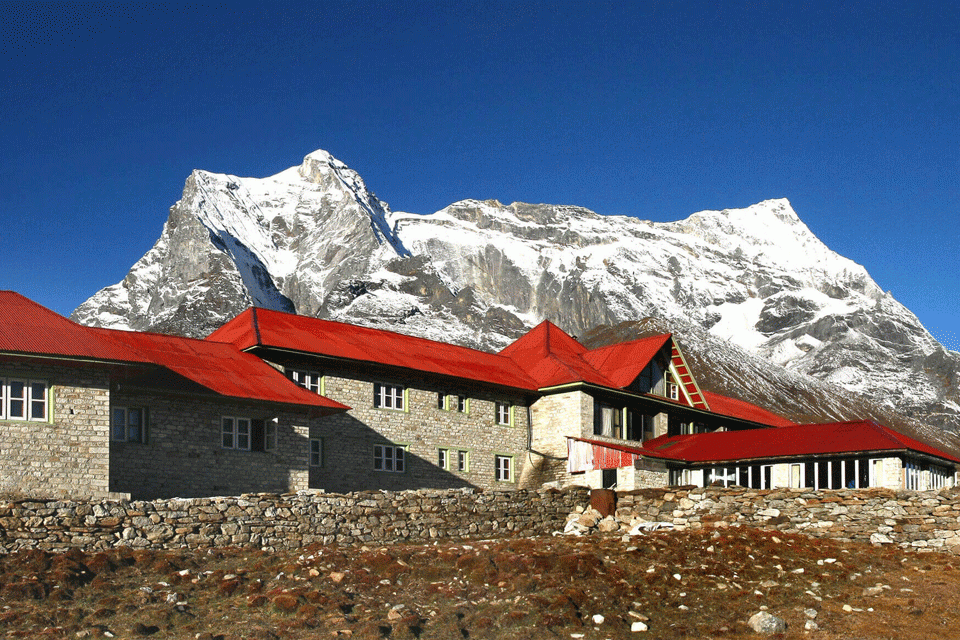
    a stone building, likely a tea house or lodge, in a high-altitude, mountainous region, typical of the kongde trek. The visible snow-capped peak suggests an altitude of several thousand meters above sea level.

     In this lengthy and detailed multi-pageblog, we will unpack why the Kongde Route is worth a high rank on your Nepal trekking to-do list, while also comparing elements of both the Kongde Route and Everest Base Camp landscape, cultural experience, comfort, sustainability, and overall trip experience.

    1. All View Over the Everest Range 

    The Kongde renaissance route has one thing your Everest Base Camp trek will not have:  the 360-degree all-machine view of Everest range at the Kongde Ri viewpoint (4,250 meters). Trekkers in this area of elevation with lofty views could see Everest (8,848m), Lhotse (8,516m), Ama Dablam (6,812m), Thamserku, Makalu (8,481m), and Cho Oyu (8,201m) all in the same view. While EBC trek takes you closer to the base of Everest, many have told me that the peak is often hidden by ridges and weather conditions. However, “Kongde” has the clearance of many remarkable -far better than expected. The mountains are organized side by side and on the morning or any sunset the mountains. It can be seen glowing gold while the sky behind is a deep blue!

    For photographers or landscape lovers, Kongde has arguably the best possible viewpoint in the Himalayas and in Nepal as well. It has allure as a natural observation deck that many do not get to see!

     2. Quiet Trails, Less people

    The classic Everest Base Camp trek receives a minimum of thousands of trekkers from every point of the globe at least once a year. Whether in the peak season (March – June and September – October), or in the shoulder season. EBC would look into penalizing in a fit back in 2023 again fall in shortage when company you will never be short of trekkers to camp for a minute.

    From Lukla to Namche Bazzer and beyond the foot traffic may be well over a couple hundred in a given day with trekkers, porters and yaks everywhere you turn. There are those who may call this part of the charm of a iconic trek, but, after walking from the trekker lodges and considerably above base elevation, there were simply too many people for too long, to consider you were on a peaceful quiet time on the trail. 

    The Kongde Route has a radically different vibe. Each year, few trekkers venture out and head towards Kongde. So you will likely have the trek largely to yourself. The forests will be quieter, the villages more authentic and you will see uninterrupted views. 

    The wonderful level of seclusion you will enjoy, provides a bond with nature. You will hear the prayer flags flapping, the leaves of the rhododendron, and the roaring Dudh Koshi River in the distance, without a hundred other trekkers as background noise. If you want solitude, mindfulness, and immersion, Kongde is the trek. 

    3. Shorter, Easier Yet Just as Rewarding.

    One of the best things about the Kongde trek is the fact that just about anyone can do it in a short amount of time. The classic trek to Everest Base Camp is an average of 12 – 14 days, which entails moving high up into altitude. With long days of trekking, those on this trek will be tested even on the most seasoned trekkers. 

    Another option is the Kongde route, which in your timeline can be done in a time frame of 6-8 days. Although it won’t be as lengthy as about 10 days, that is equivalent to experiences, with Sherpas families living in their villages, hiking alpine forests, and the magnificent mountains, with opportunities to partake. The trek will usually proceed with an exhilarating flight from Kathmandu to Lukla, then you hike from Phakding to Namche Bazaar, then to Thame, and Kongde.

    On this route you will trek below 4300 m, which should provide some comfort in terms of altitude sickness. While you trek you can absolutely relax and enjoy the comforts of the magical Himalayas all around you. If this is your first time to Nepal, you will find this great trip. If you don’t have much time, or if you just wanted a short moderate trek with the best value and satisfaction. 
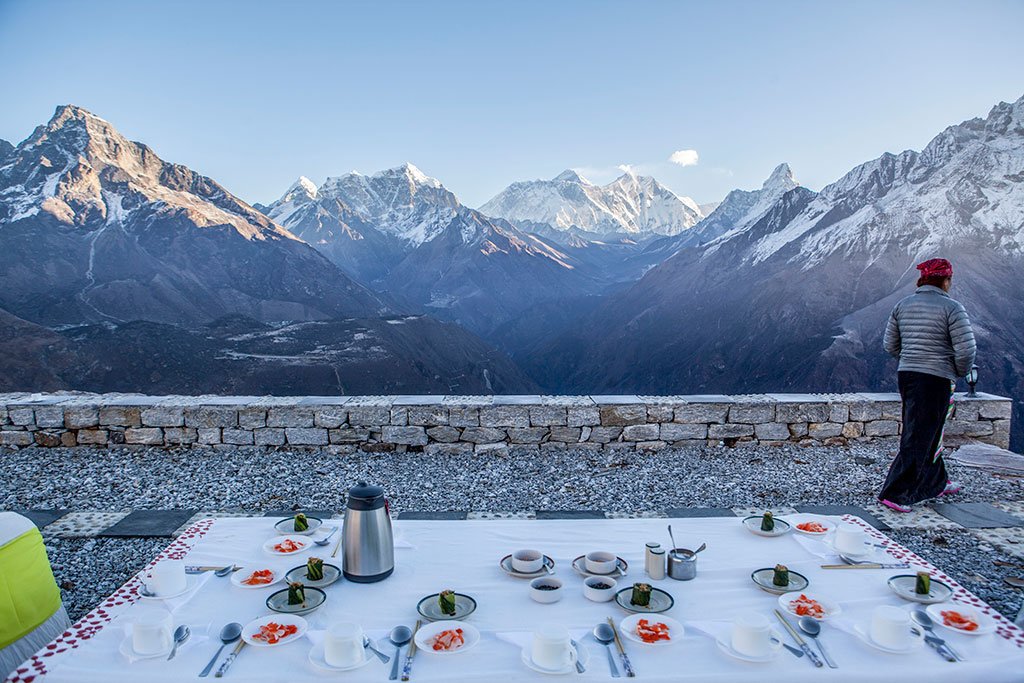
    Breakfast table in the foreground and majestic, snow-capped kondge mountains in the background, is visually similar to locations found in the Himalayas, specifically around areas like the Annapurna Base Camp, Ladakh, and Uttarakhand.

    4. Luxury deep in the Himalayas

    Although the EBC has teahouses that are comfortable to basic, most of the time they are rustic, functional, and not luxury. Though at some places, such as the Kongde region, we have Yeti Mountain Home Kongde, which is one of the best high-end lodges in the Everest region!

    Nestled deep in the Dudh Koshi Valley, the Yeti Mountain Home offers modern conveniences at over 4,000 meters, with stunning views. Each room has its own private balcony and view of Everest, comfortable interiors, and conveniences up to Western standards. Iced coffee, or a meal sourcing from the area, while you can see the rays of sunshine touching the top of Everest from the dining room of a comfortable, cozy lodge in the Himalayas–it isn’t so bad, right?! This is the combination of convenience and adventure we love about the Kongde trek. A classic trek, designed for the nature enthusiast who can’t wait to sleep in a bed at the end of the day, ogie that wants to return to the comforts of home.

    5. Authentic Sherpa Culture

    A notable aspect of trekking in the Everest region is the way of life of the Sherpa peoples. The main trekking route will take travelers through the main Sherpa villages of Namche Bazaar, Tengboche, and Dingboche. All of which have been affected by tourism commercially, and all of which have cafes, bakeries, and shops for tourists to buy souvenirs. The Kongde Route takes trekkers around less commercially influenced Sherpa communities, including Thame, Toktok and Kongde village itself.

    You can witness unrefined traditions and lifestyles in Khumbu. You will see people farming in the fields. Hear the sounds of the ancient monasteries having their monks chant throughout the day. Visit local tea in the late afternoon with Sherpa families, who have grown up in Khumbu for generations, if not hundreds of years.

    If you want to, you can stop by Thame, and stop by Thame Monastery. One of the oldest monasteries in the Khumbu and an important monastery established for over 300 years. Thame has produced several well-known climbers, including Apa Sherpa, who holds the most summits of Everest record of all time. On the Kongde route, you will experience the most authentic way of living for the Sherpas, that has not been commercialized along the typical trek of the Khumbu. 

    6. Less Altitude Stress – More Comfort (more pleasure) 

    A reason that trekkers take the Kongde Route, is the extra altitude gain than to Everest base camp trek.To compare the Kongde trek against the Everest base camp trek, the maximum height for Kongde is about 4250 meters, while the Everest base camp maximum is 5364 meters (not including the 5545 meters). 

    Offering more than 1000 meters of altitude difference minimizes some of the risk of Acute Mountain Sickness. You will be able to hike at ease, enjoy the views, and have peaceful nights with stunning mountain range views.

    Thus, the Kongde Route works well for:

    •  Families with teenagers or older family members.
    •  First-time trekkers who want to trek longer in the Himalayas, safely.
    •  People who don’t want to trek at very high altitudes.
    •  This will allow you to enjoy the spirit of the Everest experience, while making it much easier for you to avoid the complication of both high altitude trekking and the complication of acclimatizing.
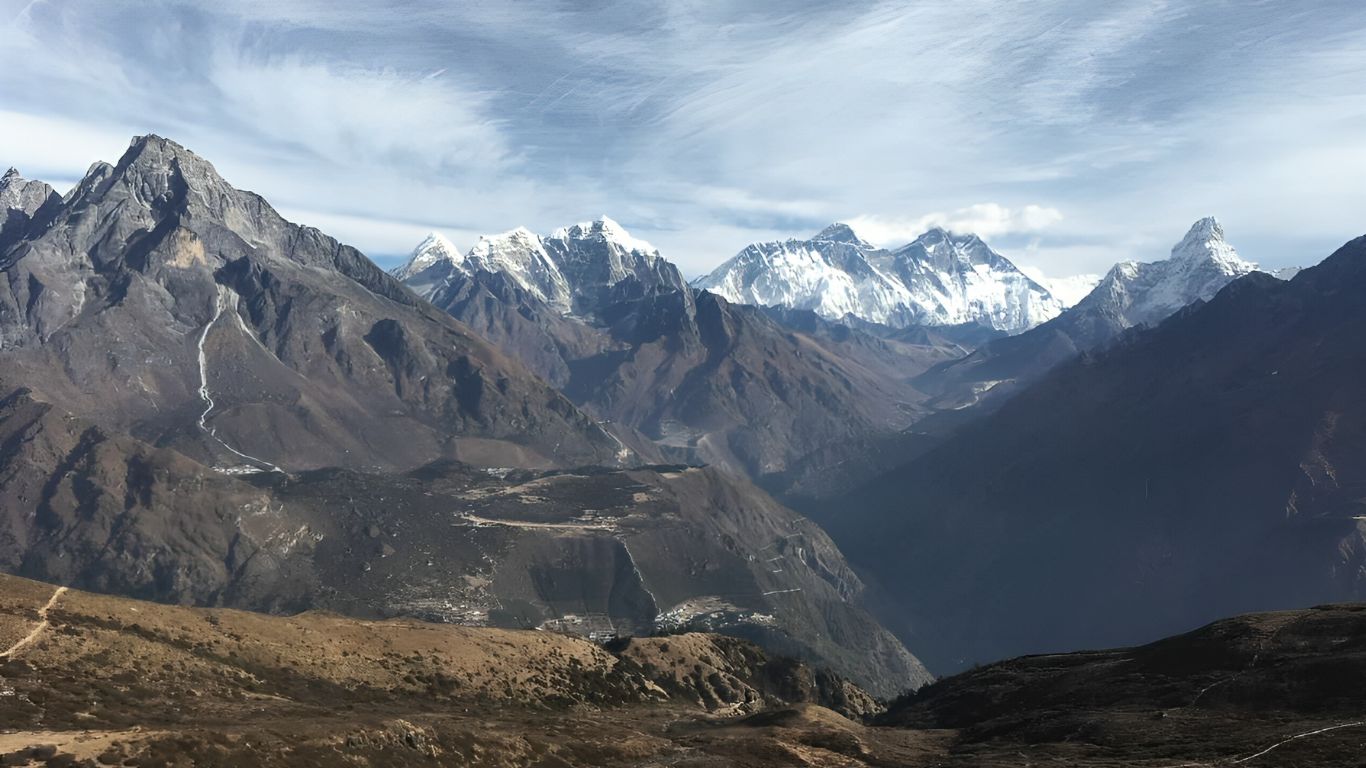
    The Kongde Ri (also known as Kwangde Ri) mountain in the Himalayas of eastern Nepal is a technically challenging peak to climb, but offers spectacular panoramic views of surrounding mountains including Mount Everest, Lhotse, Makalu, and Ama Dablam.

    7. Photographically Unparalleled Scenery

    The Kongde Route is a photographer’s dream. From the view point at Kongde Ri, you get sweeping and uninterrupted views of Everest and all of the peaks along the way. You will see nowhere else.

    In contrast to EBC, you can see Everest, but only at the view point and surrounding ridges obstruct your view since your are in a valley at Kongde you will see beautiful unobstructed views of the peaks.

    In the morning golden and orange hues cover the peaks, and in the evening crimson and violet colors sweep across the rugged mountain range. You’ll have crisp air with dramatic light and no shortage of opportunnities for unique falsely view perspectives photo perspectives.

    You’ll also be able to capture:   

    • Stone wall traditional Sherpa houses with prayer flags. 
    • Forest trails with gorgeous rhododendron blossoms (in the spring).
    • The turquoise Dudh Koshi River lazily flows below. 
    • Night skies full of stars with the Milky Way slightly eclipsing Everest.
    • Whether you are a professional photographer, or just a casual-shutterbug, Kongde will offer shots/images that will remain in your heart and intuition for life. 

    8. Ideal for the Off-the-Beaten-Path Adventurer

    The Kongde Route is intended for those who would choose exploration over the mainstream.It is not whether there is a popular route or not. It is about finding a new hidden beauty of the Himalayas.

    Along the way, you can take short side trips. Such as visiting the Thame monastery, checking out the local yak pastures, or hiking up to nearby viewpoints to gain different perspectives on the Everest range.  

    You may even see climbers practicing for their expeditions because Thame and the surrounding areas are famous for Sherpa climbers. It is in these locations that you will hear about Everest ascents and experience the region’s spirit, culture, and faith.  If you have already trekked the classic EBC, the Kongde route will provide you a unique and newer path to the same legendary mountains you trekked on the EBC.

    9. Environmental Sustainability and responsible trekking.

    Tourism is one of the major keystones of the Khumbu economy. However, the density of visitors on the Everest Base Camp (EBC) trek is beginning to have scientific impacts in terms of waste disposal, trail erosion, and deforestation.The Kongde Route, being a considerably lesser-traveled trek, gives trekkers an option for a more sustainable trek in that its hostels, such as Yeti Mountain Home, strive for sustainability in:

    – Solar heated and lit accommodations

    – Waste recycling

    – Eating based on local food and materials

    By trekking to Kongde, trekkers are engaging in responsible tourism that preserves the sensitive ecosystem of the Himalayan environment by minimizing their impact on the environment, and positively contributing to the local community members who rely on the small scale sustainable tourism experience.

    10. Balanced Itinerary of Adventure, Culture and Comfort

    Undoubtedly the Kongde trek gives you a best-of-both-worlds experience. You have the adventure of being up in the altitude, learning a new culture, and your accommodation will be comfortable each evening. Each day you wake up on the trek you will experience something new and different- swinging bridges over roaring rivers, walking through woods of pine trees, visiting monasteries and then back to the lodge for hot meals while looking at the mountains in the evening sky.

    The trek is adventurous enough that you feel an accomplishment but easy going enough that you can take in every second without worries.  A trek that is adventurous but still easy going opens up to levels of experience from the very experienced to the lay person wanting a trek into the Himalayas that was simple but memorable. 

    When is the ideal time to hike the Kongde trail? 

    Spring (March to May) or Autumn (September to November) provides the best opportunity to trek the Kongde trail in Nepal in its prime trekking season. 

    Each of the trekking seasons has its own beauty and offers a different experience, while other months can very much add beauty, strife, or serenity depending on whether you want something unique to trek. 

    Spring (March to May)

    In spring, the hills come alive with bright reddish blooms of rhododendrons, magnolias, and alpine flowers along the trails making it perfect for photographers and it is stunning. The temperature ranges from a relatively mild 10 degrees C to 20 degrees C at low altitude and there are clear skies, often featuring the best views of peaks including Everest, Ama Dablam, Thamserku, and others. If you want warm days, busy trails and incredible scenery among all the different shades of green – then Spring is for you. 

    Autumn (September to November) 

    There are many people who argue that Autumn is the best hiking season in and around the Kongde Trail in the Everest region of Nepal. After the monsoon rain, it will be fresh air, cool temperature and no dust!Visibility is at incredible prospects, and the weather is fairly stable except for normal atmospheric conditions. Days can have very pleasant warm temperatures with nights being cool and refreshing. While great weather will bring many more fellow hikers on the Kongde Trail, the mountain views and golden landscape are worth the extra hikers.

    Given the changing of the seasons, and the implied notion of adventure, if you are looking for an off-the-beaten-path experience, an option for you would be to travel in the winter months if your schedule allows. The winter season will provide you with an opportunity to travel on a calmer and generally opportune hike.
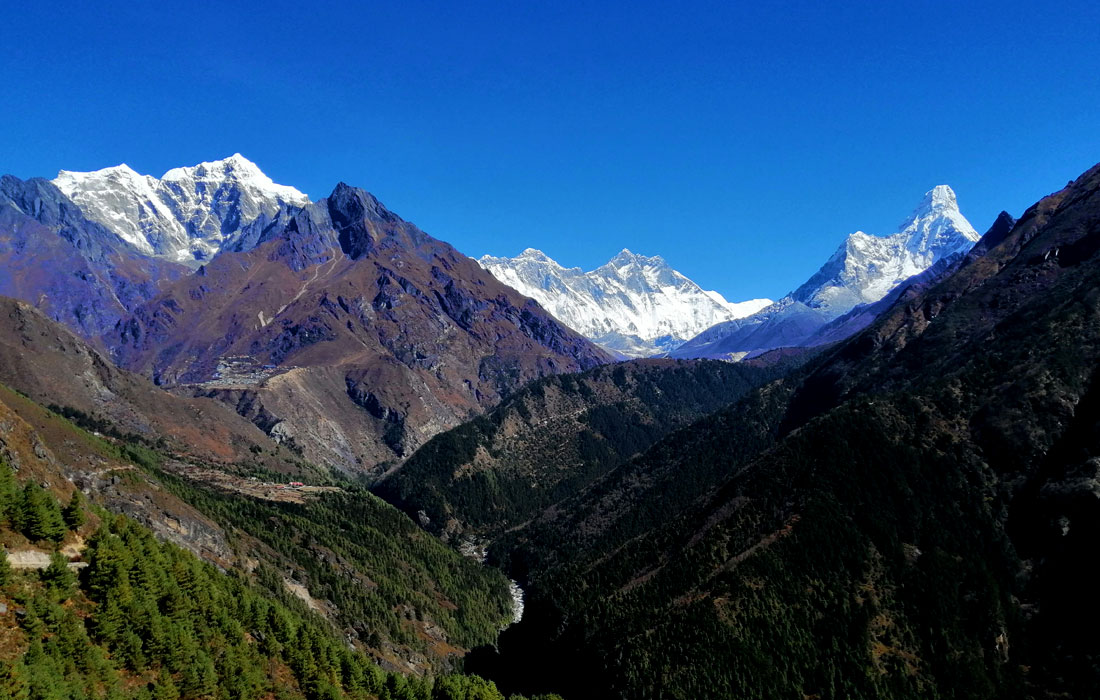
    The image on the screen is likely a photograph of the Kongde Ri mountain and surrounding peaks in the Himalayas of eastern Nepal.

    Winter months (December to February) 

    Winter travel is a completely different, but equally satisfying venture. Little to no trekkers on the trail, breathtaking scenery with sunny skies, and a quietness you cannot find at other times of the year. Just know that at night when the cold snap can dip below freezing temperatures especially high above the ground at the 3000 meters mark (10,000 feet). If you want peace and quiet you will have a phenomenal opportunity to see the beauty of the stillness of the mountains!

    Monsoon Months (June to August) – Best Not to Trek

    The heavy rains that accompany summer monsoon season will create slippery and muddy trails, blocked views as the mountains will be covered in low clouds, and an issue of leeches in some of the lower forested region of the trek. Flights to and from Lukla or flights into Tenzing–Hillary Airport will be delayed due to poor visibility. Unless you are an experienced trekker who is flexible with travel, do not attempt to trek the Kongde Route in the monsoon months.

    Permits needed to Trek the Kongde Trek

    To trek in the Kongde region, which is a part of the Everest region, you will need two permits as outlined below:

    Sagarmatha National Park Entry Permit

    This permit allows you to enter the national park and the protected area around Mt. Everest.

    You can obtain this permit in Kathmandu (Tourism Board Office, Bhrikutimandap) or at the entrance gate of the park in Monjo.

    Cost: NPR 3,000 per person for foreigners; NPR 1,500 for SAARC nationals.

    Khumbu Pasang Lhamu Rural Municipality Entry Permit

    This is a local government permit and replaces the older TIMS card for the Everest area.

    You can obtain this permit at the Municipality Office in Lukla or at the entry checkpoint in Monjo.

    Cost: NPR 2,000 per person.

    Be sure that you take both permits, as checkpoints can be seen along the route.

    Conclusion

    The Everest Base Camp trek can be called a classic as an adventurer’s rite of passage all over the world. But Kongde is something really special: a quiet, panoramic, cultural experience, epitomising the Himalayas, without the rush, the crowds or the altitude. It’s ideal for trekkers who want to escape the bustle, photographers who want amazing views, and visitors who want an authentic experience, with comfort and style.

     The Kongde trek is one of the best alternatives to Everest with shorter timelines, lower difficulty levels and amazing scenery. 

    So, if you are going to plan your next trip in the Himalayas, avoid the crowds and let Kongde’s near empty trails, and golden peaks, redefine what adventure and trekking in the Everest region means.

  • Flight to the Top of Everest: What Can I Expect?

    Flight to the Top of Everest: What Can I Expect?

    Flight to the Top of Everest: What Can I Expect?

    When I updated my arrival in Kathmandu, I already mentioned how taken I was by the beautiful chaos of the streets, the bright, colorful (and prayer flags), the temples, and yet one thing was still forgotten on my mind, and that was that I needed to get to Mt. Everest. Like many explorers and adventurers who have come before, I had a long-distance trek that included trekking to Everest Base Camp, but I ran out of time. That was when Everest Mountain Flight caught my eye. An opportunity to fly over the highest mountain range in under 60 minutes. With only my own thoughts to interrupt me, I booked the trip. This is my diary entry back that morning, what I experienced, what I saw, and why I think it was worth every single second.  

    Red and white helicopter mid-air in the Himalayas, with snow-capped mountains and a clear blue sky in the background.

    Waking up to a dream

    It began when my alarm clock went off at 5:00 AM in Kathmandu. Once I was out of bed, I still had a mix of excitement and sleepiness. The taxi ride to Tribhuvan International Airport created quasi-quiet before the chaos. The city was still waking up when I got there. 

    When I got in line for check-in, I was standing beside a small group of travelers and couples, who and I would assume, they just settled out of their own parties of friends. You could almost feel it. We were headed to Everest. 

    After a few minutes, we were led out onto a little airplane. One you would not normally see at home. A 16-seat airplane with a window for (almost) every seat. I remember telling myself it was an airplane, no, it’s a portal to a different world. 

    Departing the Valley

    It didn’t take long for the city of Kathmandu to begin diminishing behind us after leaving the runway. The assortment of temples, rooftops, and dusty streets started to fade away into colorful designs and patterns underneath. And within a few minutes, we began to see the snow-capped peaks of the Himalayas. 

    The stewardess(a woman who is employed to look after the passengers on a ship or aircraft) passed around a laminated map of the mountains around us. The peaks Everest, Lhotse, Makalu, and Cho Oyu jumped off the map. They seemed surreal to me now, mountains I had only laid eyes on previously in a book or documentary. Now I was in an airplane, flying to my upcoming adventure. The sun gradually rose, lighting up the mountains. Clouds tumbled behind us, and for that moment, I truly felt as though I’d left the Earth.

    Looking into the face of Everest,

    We were on the flight, and the pilot came on the speaker, if you look out of the left side of the plane, you can see Everest.”  I put my forehead on the cold glass, and there it was, Mt. Everest. 

    At first, even at that distance, it didn’t appear to be any larger than any of the other peaks – but after looking at it long enough, it became apparent to me that it was traditionally higher than the other peaks and held itself quietly dominant over everything else around it. Everest was capped with the recognizable pyramid peak, sparkling in the morning light. My chest tightened – I felt unexpected awe. I felt disbelief. I felt grateful.

    Man posing with arms outstretched in front of a yellow helicopter with snowy Himalayan peaks and a clear blue sky in the background.

    The flight attendant gently touched me on the shoulder and invited me to enter the cockpit. I carefully climbed up and stood behind the pilots as they effortlessly glided through the clouds. It was a very intense experience from this view with a full 360-degree aspect of the tallest mountains in the world. Everest was center stage on the horizon, with Lhotse and Nuptse at its sides, and off to the side, a charming Makalu looking elegant as well.

    I attempted to snap pictures of the site; however, the view was not the same as the experience in my eyes. After a minute or two, I finally decided to put my camera down and just enjoy it.

    More Than Everest

    The neat part about the flight to Everest is that the flight is more than just Everest. I saw Cho Oyu, the Turquoise Goddess, shining brightly in blues. Makalu stood sharp like a pyramid of ice. Gosaithan (Shishapangma) lay long, wide, and viewable beneath a mass of snow. The glaciers below us resembled silver-colored rivers wading through valleys.

    Each peak seemed to have a singular story to tell, and I felt like I should whisper their names to myself like a little prayer.

    Back to Kathmandu

    Almost an hour afterwards, we began to circle. I took one last long pause over the mountains. Everest was behind me, formally, but I still had that first glimpse in my chest.

    Then, as we dipped down into Kathmandu Valley, the city slowly emerged. The contrast was almost unbelievable from the pristine, sacred Himalayas, back to the chaos of city streets. All in barely an hour.

    As soon as we touched down, the airline gave me a certificate of flight. Just a slip of paper, but somehow felt more like a badge of memory.

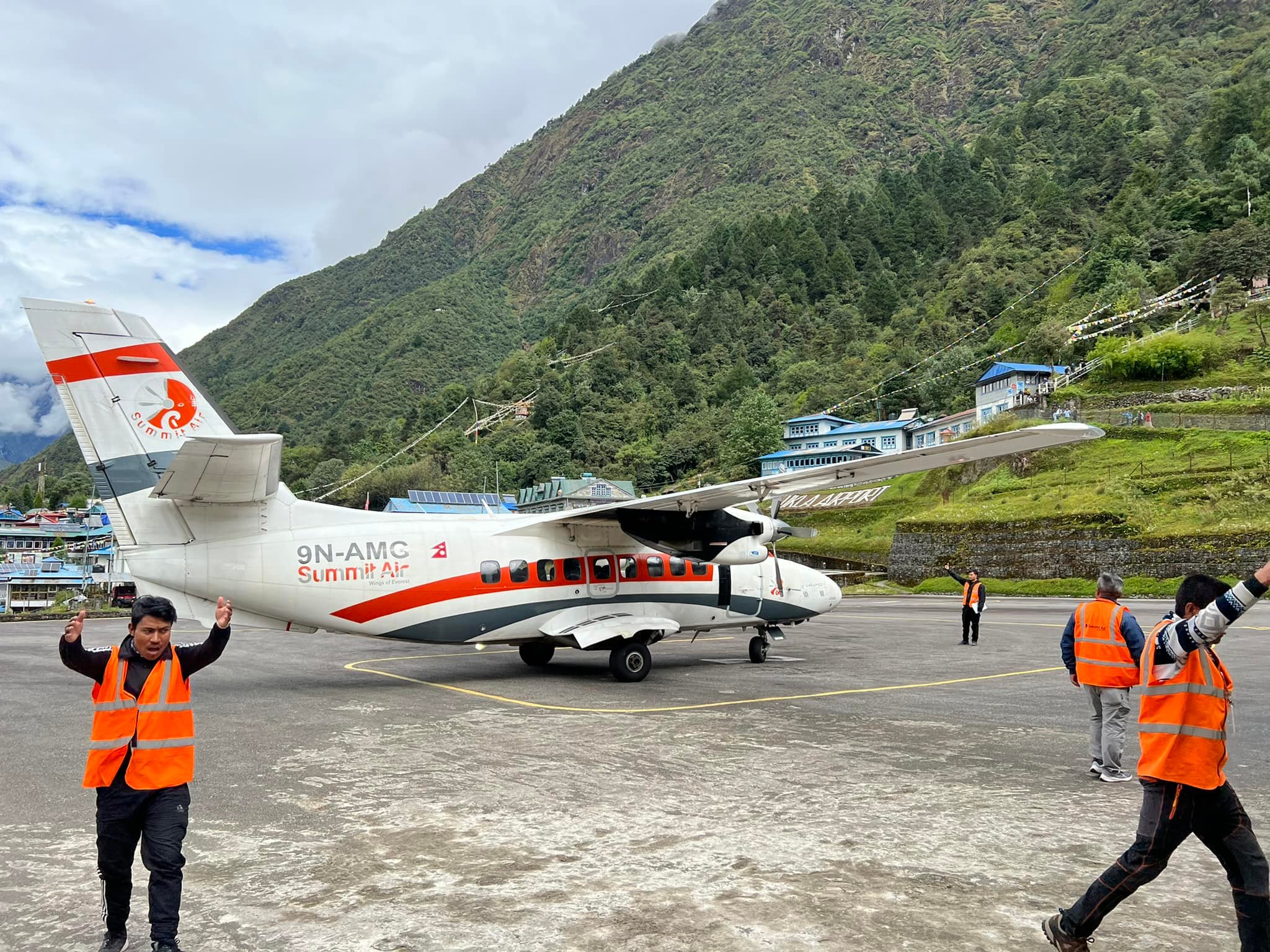
    Lukla Airport & Summit air is waiting for the passengers to on board

    Was It Worth the Cost?

    The ticket cost around $200 USD – quite a bit for one hour of flying. However, to tell you the truth, it was worth every single penny. I experienced a view of the highest mountain in the world and did not have to hike for weeks to see it. I experienced something few people ever will. I came home with not just photographs, but the memory of an experience I will tell stories of forever. Some may say that it is simply a tourist destination, but for me, I had a spiritual moment with one of nature’s great landmarks. 

    What I Learned (and Recommendations For You)

    Based on my experience, some things I would recommend to anyone who is considering this flight are:

    Go in the fall or spring – the clear blue skies make all the difference.

    Book as far in advance as possible – the flights fill quickly, especially during peak seasons.

    Sit on the left side of the plane first – better views of mountains on the way there and back.

    Don’t hurry to take too many pictures – get a few and then just appreciate being there.

    Be prepared for delays – the weather rules everything in the Himalayas.

    Beyond the Flight

    The day didn’t finish at the airport. Still high from the flight, I spent the rest of my afternoon starting to explore Kathmandu. The Boudhanath Stupa was a good place, where I lit a butter lamp and silently thanked the universe for allowing me to see Everest. I then had an amazing hot cup of masala tea in Thamel, mentally watching the mountain views in my mind like a private movie only I could play.

    Final Thoughts

    A flight to the top of Everest is not an adventure – it is a humbling reminder of how we are all comparatively small in the failing of nature yet so lucky to see it. If you ever end up in Nepal and don’t have time to do a longer trek, do it! Have the flight. Let Everest greet you from the mountain view.

    As I finish my journal entry from that morning, one sentence keeps replaying in my head:

    I did not ascend Everest; rather, Everest ascended in me. 

  • Death Rate on Mount Everest Climbing

    Death Rate on Mount Everest Climbing

    Death Rate on Mount Everest Climbing: The Harsh Truth Behind the World’s Tallest Peak.

    For centuries, Mount Everest has represented human determination, bravery, and dreams. Every year, innumerable climbers embark on the journey from different places in the globe to stand on the top of the highest point of the Earth, 8,848.86 meters (29,031 ft) above sea level. Unfortunately, there is a more sobering truth that is not seen in the photo from the summit .Mount Everest is one of the most dangerous places on Earth. For anyone contemplating the ultimate attempt at adventure, it is important to address the death rate of climbing Mount Everest and understand the prevalence of risk versus death rate, and the likely risk opinions. 

    Climbing high on Mount Everest

    So Just How Dangerous is Everest?

    While it may be the highest mountain in the world, Everest is not the most challenging mountaineering technical ascent. The dangers here come from its altitude, the unpredictable weather, or the harsh environments. Since the first successful ascent by Sir Edmund Hillary and Tenzing Norgay in 1953, over 330 climbers have died climbing Everest. 

    No doubt all the improvements in gear, logistics, and professionally experienced guides have made climbing Everest safer than in the past, but the death toll will still keep slowly rising annually, whilst more people continue to climb the mountain. The thin air, howling winds, cold, and icefalls, even if you are prepared, Everest is never fully achieved. 

    Death Rate Statistics on Mount Everest:

    The overall mortality rate of climbers on Mount Everest is between1%1-2%, indicating that for every 100 climbers, at least one climber will not return. While that percentage may not seem large, and it actually looks worse, when we consider that around 6000 summits of Mount Everest have been then 300 climbers will remain forever entombed on the mountain. In past years (1950s to 1990s), the death rate percentage was often much higher, approximately 4-5%.

    Despite better equipment for climbing, better communication, and better rescue skills, the annual average mortality still remains just about 1% each year.The “Death Zone” above 8,000 meters appears to be the place where the climbers die from lack of oxygen and fatigue.It is safer to climb Everest today than it ever has been, but death risk is still a very real possibility.

    Mount_Everest,_Altitudes_Of_Various_Discoveries,_The_Three_Steps,_And_Its_Summit

    Common Causes of Death on Mount Everest.

    To understand the most common causes of death on Everest is to appreciate how unpredictable the climb can be:

    1. Altitude Sickness.

    The lack of oxygen at high altitude can bring on symptoms of Acute Mountain Sickness (AMS), High Altitude Pulmonary Edema (HAPE), or High Altitude Cerebral Edema (HACE). All of which can lead to death if not treated in time.

    2. Severe Weather Conditions

    Storms can come on with little or no notice and leave climbers disoriented in a whiteout situation or freezing temperatures. Wind chills can bring temperatures to approximately -60°C, which creates a nearly impossible survival situation.

    3. Avalanches and Icefall Collapse

    The Khumbu Icefall, which is located just above Base Camp, is one of the most dangerous portions of the ascent. Blocks of ice can collapse at any moment without warning, which can bury climbers under several tons of snow and ice.

    4. Fatigue and Physical Exhaustion

    It is possible for staggering up to the summit to take longer than 12 hours and usually happens after climbers have spent up to several weeks at high altitude making the ascent. Climbers are often too fatigued and physically exhausted trying to climb their way through thin air and are too weak to attempt a descent.

    5. Falls and Accidents

    Narrow ridges, slippery ice, and unstable ropes have led to numerous falls and death particularly in the aforementioned area known as the Hillary Step or in exposed climbing areas.

    6. Delays No Traffic

    Unfortunately, overcrowding brings on an additional danger in recent years. Climbers can wait in line for hours very near the top of the summit after they have run out and do not make the move to turn back either.

    The Role of Sherpas in Safety

    Sherpas, the renowned mountain guides of Nepal, help to reduce the death rate on Everest. They place fixed ropes, deliver supplies and guide climbers safely through dangerous terrain. Though skilled in climbing and endurance, many Sherpas face serious risks because many recorded deaths have been Sherpas who sacrificed their lives helping the climbing expeditions.

    Is Climbing Everest Worth the Risk?

    For many, standing on top of the world is a dream that has persisted all their life! But the stats show tundra and high altitudes come at a cost. The actual costs are enormous. The physical toll is nothing less than risking your life. Tragically, even highly trained athletes die on the slopes of Everest.

    If all you want to do is see Everest, you don’t have to risk your life to do so.

    A Safer Way: Trek to Everest Base Camp

    The Everest Base Camp Trek (EBC) gives adventurers the opportunity to experience the spectacular scenery, Sherpas, and fabulous views in the Himalayas while not having to enter the deadly altitude of the “Death Zone.” At Everest Base Camp, you will find it is a lot higher at 5,364 m (17,598 ft) than your sleeping bag. It is not the summit at 8,848 m (29,029 ft), but it is “high” enough to be a little taste of extreme altitude traffic with consideration to going for the summit attempt.

    You will ascend green valleys, walk on a suspension bridge, travel to Namche Bazaar, and be up close with Everest, minus all the risk and danger of climbing. It is a great experience for an adventurer who wants to have an Everest experience without risking their life.

    In Conclusion

    The climbing death rate at Everest will offer humanity a sobering reminder of how nature has been, and continues to be, much greater than we are as humans. Though technology and better organization have, or at the very least should have, reduced the death rate, the reality is that Everest is still incredibly dry and treacherous.

    For many adventurers, achieving the trek to the Base Camp is a way to satisfy an adrenaline experience while being awed by Everest’s beauty and culture, and successfully preserving life. If Everest calls you, do remember: you don’t have to summit the top of the world to experience its presence and energy. Sometimes, just getting to the Base Camp is the real summit.

  • Where is Mount Everest Located? Everything You Need to Know

    Where is Mount Everest Located? Everything You Need to Know

    Where is Mount Everest Located? Everything You Need to Know

    Mt. Everest is recognized as the highest mountain in the world, but it also represents adventure, spirituality, and nature. This brings us to the questio:, where is Mt. Everest? The answer can be gathered from looking at the geography, culture and the history of the Himalaya. In this blog I will clarify, what is Mt. Everest and all the names associated with Mt. Everest as a traveler take you to Mt. Everest. 

    Mount_Everest,_Altitudes_Of_Various_Discoveries,_The_Three_Steps,_And_Its_Summit


    Where is Mt. Everest Specifically

    Mt. Everest is part of the Himalaya mountain range at the border of Nepal and Tibet (an autonomous region of China). If you were to consider the slop of the mountain that face south as you approach the mountain, than that slope would associate Mt. Everest with Nepal, however if were to consider the slope of Mt. Everest that faced north, than it would associate Mt. Everest with Tibet. To be more technically detailed, if I give you Mt. Everest’s latitude and longitude you can see Mt. Everest more defined 27.9881° N latitude and 86.9250° E longitude, now you can envision where Mt. Everest is placed on a map.

    Mount Everest is located in Sagarmatha National Park in Nepal, a UNESCO World Heritage Site of unbelievably unique wildlife such as snow leopards, and red pandas, as well as Himalayan tahr. Most climbers fly into Lukla and start off acclimatizing on their trek to the summit of the mountain. This trek is also the same one to Everest Base Camp for hikers. In order to reach Mount Everest from the Tibetan side you will need to enter into the Tibet Autonomous Region. When you enter from this side you are not only entering into a completely different place, but the procedure here is more complicated as you’ll require special permits for this travel as this is more off the beaten path, less so with in the area of trekking tourism.

    So Everest does not only have a border with two sides, it has 2 different experiences: a warm trekking culture on the Nepalese side, and the mystical highland side of Tibet

    Mount Everest’s Height and Surrounding Peaks

    At an elevation of 8,849 meters (29,032 feet) above sea level, Mount Everest is the tallest mountain in the world. To clarify, it is not an entirely separate mountain; rather, it is a subset of one mountain that makes up the Mahalangur Himal sub-range of the Himalaya mountain range, which is fill with many amazing, tall, beautiful mountain peaks. The south of Mount Everest is another quite large mountain called Lhotse, which is actually the fourth tallest mountain in the world, at 8,516. 

    To the west of Everest is Nuptse at 7,861 meters, then Changtse to the north, again of Everest. All of these mountains in the neighborhood of Everest add spectacular structural views which climbers and trekkers will never forget. When trekking to base camp on that trail, those mountains seem to construct a cathedral missionary effect. By all means Everest is awe inspiring based on its sheer height, but there are scientific instructional implications because Everest rises each year due to the Indian tectonic plate continually converging upon the surface of the Eurasian tectonic plate. In lay terms, the tallest mountain in the world keeps getting taller.

    Climbing high on Mount Everest

    What Do Nepal and Tibet Call Mount Everest?

    While native English speakers refer to the peak as Mount Everest, it has more respectful names in context.

    ·   In Nepali, the mountain is called Sagarmatha, which roughly translates into “Goddess of the Sky.” This is significant because it signifies a spiritual presence of the mountain within its local context.

    ·   The Tibetan name is Chomolungma, which less literally but more readily translates to “Goddess Mother of the World,” reminding Tibetans the mountain is more than a mountain…it is a mother.

    ·   Lastly, Everest was named after Sir George Everest, the British Surveyor-General of India in the Nineteenth Century.

    Every name has a significance. For local people, descent of the mountain is a spiritual experience, and for a western explorer, it is just a geospatial phenomenon. The names provide the explorer with something for beyond the summit to recognize in the name, a worthwhile recognition.

    The Nepal Side vs. the Tibet Side

    Nepal (South Side)

    The majority of the visitors will experience Everest from the side of Nepal. Visitors usually start from Kathmandu, and after a short but exhilarating flight to Lukla Airport, often regarded as one of the world’s more adventurous airstrips, trekkers then begin the hike from Lukla through villages, suspension bridges, and alpine forests until they reach Everest Base Camp.

    The side of Nepal is known not only for the views of Everest, but also for the cultural experience. Places like Namche Bazaar give you a sample of life, and ancient monasteries still remind you that the Himalayas are as spiritual as they are physical.

    Tibet (North Side)

    The side of Tibet offers a different but equally fascinating perspective. Here you can drive all the way to North Everest Base Camp, without hiking or trekking. That said, you will need to have permits that are tightly controll by the Chinese for entry (and there are generally fewer travelers than on the Nepal side).

    The Tibetan side feels more remote: vast plains, dry landscapes, and fewer settlements. Hike or drive, it is more accessible to technically get to base camp, but the remoteness and searching for refreshments make it more of a journey where the Nepal side there are less regulations and you can learn about the culture more freely.

    Both sides reveal different personalities of Mt. Everest – when in the Nepal side it is more about adventure, community and sustainability. On the Tibetan side, it is more about isolation and spiritual landscapes.

    sent depicts a climber on the treacherous slopes of Mount Everest, the world's highest peak.

    Why Mount Everest’s Location Matters

    The significance of Mount Everest’s location is multifaceted. From a geographical perspective, it serves as a natural border between Nepal and Tibet. Spiritually, it is also an important site of worship for both groups. Economically, Mount Everest is ultimately what draws thousands of trekkers and climbers to Nepal each year and provides the largest source of tourism for the country.

    Mount Everest is also symbolic of geological power on Earth. It was create over millions of years as a result of the technical collision of the Indian plate colliding with the Eurasian plate and still rises a few millimeters each year. Geologists study the geology of Mount Everest further our understanding of how the Earth moves and the changes in climate on Earth.

    Lastly, talking about travelers and tourism, Mount Everest’s location makes it the most desirable bucket-list location.Mount Everest calls the edge of one of the most isolated, but accessible places on earth, bringing together the most amazing experience of climbing, beauty, and culture. 

    Experiencing Mount Everest: how to get there. 

    There are many ways to experience Mount Everest depending on time, budget, and ability: 

    1. Everest Base Camp Trek (Nepal) – The “classic” way to experience Everest is the 12-14 day trek around Everest Base Camp where you can walk in the footsteps of the climbers, enjoying truly spectacular views along the way. 
    2. Helicopter tour (Nepal) – If you do not have the time or desire to trek for 12-14 days, you can fly to Everest Base Camp in a helicopter, or fly by summit of Everest on the same day. 
    3. Overland Tour (Tibet) – You can drive from Lhasa across the Tibetan Plateau to visit the north side of Everest.This is a vastly different experience in terms of culture compare to the trek in Nepal.

        4.  Mountain Flight (Nepal) – If, for any reason, you do not wish to hike or climb to Everest, you can        see Everest and the other giants of the Himalayas on a sightseeing flight from Kathmandu.

    Despite which way you take to experience Everest, each option will give you a one of a kind experience, whether it was trudging through heat and sun up a treacherous, windy trail to North Base Camp, soaring across a spectacular valley in a helicopter or to yourself and group up to the overland pass way up to the north.

    FAQs about Mount Everest’s Location

    1. Does Mount Everest belong solely to Nepal?

    Not exclusively. It runs along the border between Nepal and Tibet (China). Climbers and trekkers usually access from the south (Nepal side) and the north slopes are in Tibet.

    2.  Can you see Everest in Kathmandu?

    Not directly. Kathmandu is in a valley surround by hills. Everest is located much further east, in the Khumbu region of Nepal. On certain occasions with amazing visibility conditions, it is possible to see it from some views. But, it would be a view from the sky with a scenic flight or if you trek in the Everest region.

    3.Which side is better to visit, Nepal or Tibet?

    It depends on what the visitor is interested in. Nepal offers trekking adventure experiences that allow for the opportunity for more cultural interactions, and it is easier to get to. Tibet is more of a road trip experience with not as many people, but also requires greater permit requirements. In the end the majority of tourists traveling to the Everest region, find that Nepal is better when both the cultural experience and access are factored in, for their experience.

    Final Thoughts

    So, where is Mount Everest? It is situate on the Nepal and Tibet border, associate with the title of “the highest mountain in the world.” However, with this statement, you learn more than a geographic fact. It also adds to your experience of Mount Everest being a gem of cultural, religious, germ, and geographic importance. Wherever you may experience Mount Everest, it adds to your own experience to know it is on the Nepal and Tibet border and associated geographic locations, and yet another element of the story/context of Mount Everest. Whether you are going on a trek to Everest Base Camp, going to get a flight over Everest, or getting a view of Everest from a plateau in Tibet just knowing where Everest is located also adds to your experience.

  • How to Prevent Altitude Based Sickness When Trekking EBC

    How to Prevent Altitude Based Sickness When Trekking EBC

    How to Prevent Altitude Based Sickness When Trekking Everest Base Camp

    No matter where you are in the world, trekking to Everest Base Camp is an incredible journey to experience. Walking among the shadows of the tallest peaks in the world, experiencing the villages, and viewing landscapes that appear they are out of dream are experiences that are rare, if not impossible, to have elsewhere. But all of that beauty and wonder brings with it one of the worst parts of trekking, sickness from altitude. 

    majestic view of snow-covered mountains, likely from the Karakoram range

    Altitude sickness or Acute Mountain Sickness (AMS) if we want to be more formal, can be common for trekkers traveling to Everest Base Camp, as this trek can take you to altitudes over 5,000 meters. If you are walking about the atmosphere at an altitude above 3,000 meters with thin air, reduced levels of oxygen, and more variable altitudes, your body will have a frightening and sometimes fatal response to this. 

    Fortunately, it turns out that just about all trekkers can take steps necessary to counter altitude based sickness, and can complete this world famous trek with little issue. 

    In this blog, I will try to provide a thoughtful plan on how to reduce the risk of altitude based sickness when trekking to Everest Base Camp, including practical steps you can take, recommendations to acclimatize the body before the trek, and health based aspects of life that one should consider when trekking.

    Understand What Altitude Sickness Is

    The first important thing to do to prevent altitude sickness is simply to know and understand what altitude sickness is. Altitude sickness occurs when your body reacts to the lesser oxygen level associated with elevation change, and is unable to acclimate quickly enough. At sea level, the level of saturation is approximately 21 percent oxygen, but as you go higher, especially above 3,000 meters, the oxygen saturation goes down and subsequently your lungs and body have to work harder to circulate enough oxygen to your blood and brain. 

    The signs and symptoms you may notice from altitude sickness can be mild signs with headache, dizziness, nausea, fatigue, and shortness of breath or can escalate to fluid build-up in the lungs or in the brain.  Tidier escalation symptoms are termed High Altitude Pulmonary Edema (HAPE) or High Altitude Cerebral Edema (HACE; these symptoms can even be life-threatening if unmediated.

    Once you understand this clearly, hopefully, it is easy to know how important the concept of prevention actually is.  You don’t wait until you get sick to take action, you have all these preventive interventions that you do ahead of time and during the trek to give your body gradual time to acclimatize.

    Ascend Slowly and Give Your Body Time

    The most important factor to minimize altitude sickness as you are trekking to Everest Base Camp is to ascend slowly. Your body needs time to adjust to the thinner air. If you rush your trek you will almost certainly increase your chances of developing altitude mountain sickness (AMS). A majority of standard itineraries will enable the Trek to occur over the 12 – 14 day duration, allowing for acclimatization and rest days. 

    For example, you fly into Lukla, which is at 2860 m, and the first day (which is the first day of the trek) trekkers generally walk to Phakding (which actually is almost a little below Lukla) on the first day of the trekking. Walking to a little lower altitude helps acclimatize your body to your trek. Following the Phakding part of trek, the trail typically goes upwards but a good plan also allows for acclimatization days in Namche Bazaar and Dingboche. Rest days are key days really since they allow your body to acclimatize to the altitude instead of just climbing.

    Group selfie on the way back to Lukla From Monjo
    Group Selfie with Kusum Kangaroo

    Remember: the trek to Everest Base Camp is not a race. Many that push the distance too fast, end up sick and/or unable to continue. Walking more slowly is good for your health, but more importantly, helps you to take the unbelievable scenery and experience the Sherpas’ intriguing culture.

    Acclimatization Days are Necessary

    Trek participants often ask why days of acclimatization are included if the plan is just get to Everest Base Camp. The reason is simple: acclimatization makes it possible for your body to function at high altitudes where there is less oxygen. The acclimatization days are not lost days; they are essential to completing the trek for the vast majority of trekkers.

    With Namche Bazaar (3,440 meters) as a base, you will spend two nights, rest on the second day hike, and return to sleep at Namche. The beautiful fixture of sleeping at a lower altitude is from a higher hike that day, called “climb high sleep low”. This method promotes a person’s acclimatization so that they can continue their trek, but they recover inflammation and oxygen deficiency from their body and recover at a lower elevation.

    Trekkers tend to stay at Dingboche (4,410 m) for one or two extra nights, also taking an acclimatization day hike up to Nagarjun Hill or Chhukung Ri. Despite these hike sounding difficult, they are extremely important for acclimatization to the high elevations you will very soon experience in Gorak Shep and Everest Base Camp.

    Too many trekkers simply skipped the acclimatization days. They are convinced that this will rob them of “valuable” time and will put them at an even greater risk of altitude sickness that could potentially disrupt their trek altogether. 

    Stay Hydrated

    Hydration is one of the best and simplest ways to prevent altitude sickness. At elevation, your body, when high altitudes increases respiratory rates and causes increased urination, is losing fluids. Dehydration can slow the body’s acclimatization process to low oxygen greatly increases the likelihood of developing headaches, feelings of fatigue, and symptoms of nausea.

    Hikers should drink AT LEAST three to four liters of water daily while hiking. This does not only mean water, but soup, tea, rehydration salts, etc. to supplement hydration and electrolytes. Many hikers also prefer to have reuseable water bottles or hydration bladders to sip water, rather than wait until their body is thirsty to drink enough fluids.

    Finally, hikers also should be mindful of their caffeine and alcohol intake while hiking. A small cup of tea or coffee is fine, however, it is important to be mindful of total amounts of caffeine consumed, since caffeine will dehydrate your body. Alcohol should be avoided all together, since it effects your hydration, as well as, your acclimatization. Being mindful of what is consumed, can help you avoid altitude related issues.

    Group photo at Phakding Before leaving for Namche Nazar
    Group Photo Taken at Phakding Hotel

    Feed Yourself Nutritiously and Balanced

    Food influences how your body adapts better to a greater altitude. Trekking burns lots of calories, and thus eating well allows your body to have enough energy to adapt and stay well. What you also regularly consume should be accounted for as well as what the quantity of food you eat.

    Meals that are high in carbohydrates are desirable because they are easily digested and will give you energy in every meal while your body is digesting food at altitude. Most treks you will see trekkers eating dal bhat, a local dish made of rice, lentils, and vegetables that is found throughout Nepal. This is a nutritious and filling meal that will provide good energy for the trek. 

    Heavy foods, such as oily greasy foods, are what you want to avoid; as you travel and eat at altitude it will be harder for your body to digest them. Instead, stick to soups, pasta dishes, rice dishes or vegetables. You also want to eat smaller portions compared to larger sizes, and not make your stomach work hard to digest a larger meal. If you eat a diet with balance it will generally keep your energy levels better and assist your bodies in minimizing food and energy to work effectively with the strain altitude brings.

    Recognizing Symptoms Early

    In this grand prevention of altitude sickness puzzle, one of the most important pieces is understanding how to recognize the symptoms early. Too many trekkers will brush off what they think are minor symptoms, like a very minimal headache, or a small amount of shortness of breath, telling themselves that these are acceptable and part of a normal acclimatization pattern. These symptoms are not — this is your system telling you that it is starting to struggle to acclimatize.

    Some common symptoms of altitude sickness are headaches, dizziness, nausea, loss of appetite, disturbed sleep, and general fatigue. If you feel any of these signs of altitude sickness you should not ignore them. Take the needed time to rest and hydrate. Do not go higher in altitude until you feel better. Continuing on with symptoms getting worse thinking that you are okay may lead to serious altitude sickness conditions, such as, HAPE and HACE.

    It also is important for trekkers to monitor each other. Sometimes you do not realize the changes in your own mood, behavior, or speech, however your trekking companions will. Always articulate how you are feeling with your group and your guide. Taking initiative to recognize symptoms of altitude sickness can be the difference between finishing a safe trek and finding yourself in a medical emergency.

    Use Preventive Medication Wisely

    Some trekkers find preventive medicines useful in reducing altitude sickness. Diamox (Acetazolamide), for example, may not have a direct fixing effect as much as it serves to improve your body acclimatization process. Many doctors recommend taking it the day before you reach altitude and continue taking it until acclimatization is complete. That said, medications should never be a substitute for normative acclimatization or tapering ascent while trekking. It is merely a supplemental aid. Nevertheless, consult your doctor for a visit before the trek to see if Diamox or any other preventative medicines are suitable for you. Of course, these medicines are all imperfect and have potential side effects.

    Many trekkers also use things like garlic soup or ginger tea and other herbal remedies, which are found and popular through the Everest region, to assist them with altitude acclimatization. The scientific evidence is limited, but these natural remedies could be helpful comfort measures and supportive in boosting hydration, which may indirectly assist or supplement acclimatization at altitude. 

    a sign for the Way to Mount Everest Base Camp (EBC) in the Himalayas of Nepal.

    Sleep Well and Rest Properly

    Sleep is one of the most valuable recovery tools the human body has, unfortunately, at altitude trekkers could have some trouble with sleep and may wake up throughout the night due to the thin air. Less sleep can lead to an increase in fatigue and increase your chances of altitude sickness. 

    To maximize your sleep, especially on an acclimatization night. Try to sleep early and give yourself plenty of time to sleep. Have a good quality sleeping bag, the warm you are at night the better your sleep will be, as being cold can break your sleep cycle. Avoid eating a heavy meal and anything with caffeine, including alcohol right before bed. Breathing exercises and herbal teas can also be a good way to unwind before bed. 

    Rest days are equally important. Even if you feel like you have energy, it is still important to give the body time to recover on a day of acclimatization. Or don’t overexert yourself on a long acclimatization day. Climbing at altitude requires the body to put in work. And it will take a little more rest for the body to recuperate to tackle the next climbing day.

    Listen to Your Body and Know When to Turn Back

    The mountains will always be there, but the most important thing is your health. One of the hardest choices a trekker can make is the decision to turn back when you have obvious symptoms of altitude sickness. However, usually this is the most important decision you will make. If your headache becomes debilitating. Or if you have been dizzy since you first walked into camp. If you find yourself confused, or short of breath, these are clear signs that you should descend as quickly as possible! When in doubt, consider the following. If you have headaches or dizziness that’s getting worse you should descend. If it’s anything worse than this, you *must* descend!

    Guides and porters are trained to recognize many of the symptoms of altitude sickness from previous expeditions. And although they may not say anything to you, it doesn’t mean they aren’t concerned. Trust their instincts and experience when they share with you when to descend.

    Sometimes descending even a couple hundred meters will make a huge difference in how you feel. Once your symptoms subside and you are feeling better, only then can you consider whether you can continue. Remember, the summit or the trek is never worth going without your health or your life!

    Train and Prepare Before the Trek

    An additional important aspect related to reducing the risk of altitude sickness. To be in shape prior to your arrival in Nepal. Being fit does not guarantee health. But it should help your body to more easily accomplish.

    You should begin preparing yourself (as long as it is months in advance of your trek). By doing short bursts of cardio, or weight workouts, regularly. This could be running, hiking, swimming, or cycling. You might also want to begin some strength training for your core and legs. Because that will aide you in long uphill hikes. If at all feasible, practice hiking with a pack loaded to the way you will hike on yourEverest Base Camp trek.

    This image is a digital illustration depicting a woman in activewear performing a yoga pose

    Again, as I have stated in my former writings. You will want to condition your mind for your hike. High altitude trekking is about patience, stamina, and flexibility. If you condition your body and your mind. You will give yourself the best chance of acclimatizing. And if you do this, you will have the best chance of enjoying the experience when it is required.

    Final thoughts

    EBC is a bucket list hike for so many people, and height sickness. It should never be a reason why you do not fulfill your dream. As long as you respect the potential dangers. Ascend slowly, take acclimatization seriously, drink plenty of water, eat good food, and listen to your body. You will mitigate anything related to altitude sickness.

    Remember while trekking – it is better to prevent than to treat altitude sickness. Respect the mountain, your body, and your health more than speed. You will succeed in getting up to Everest Base Camp. And enjoy making your way through one of the most incredible landscapes in the world. 


  • Why is the Everest Base Camp Trek So Popular?

    Why is the Everest Base Camp Trek So Popular?

    Why is the Everest Base Camp Trek So Popular?

    Few adventures can rival the Everest Base Camp trek in the world today. For nearly every traveler or adventure-seeking trekker, standing at the base of the world’s highest mountain is a lifelong dream. Every year, thousands of individuals from all over the globe travel to Nepal to accomplish this arduous and rewarding journey. But what has caused the trek to Everest Base Camp to be so exceedingly popular right around the world?

    In part, it is enough to describe a combination of spectacular beauty, cultural richness, historical value, aspects of adventure, and, of course, achievement on the personal level. In thisblog, we will give you many reasons for the world-renowned trek.

    1. The Awe of Mount Everest: The Highest Mountain on Earth

    At 8,848.86 meters (29,031.7 feet), Mount Everest has always captivated the human race, and merely the idea of trekking to Base Camp at 5,364 meters (17,598 feet) and witnessing the immensity of the Great Himalayas generates electricity.

    Everest Base Camp trek is popular for its spectacular, ever-changing mountain scenery, including views of Mount Everest and other towering peaks

    Compared to summiting Everest, which requires the absolute maximum of skills, training, and resources available, simply getting to Base Camp is possible for all trekking adventure enthusiasts while experiencing an adventure in endurance and discovery that takes you steps away from the highest point on Earth. Many are telling us that once they arrived at the Base Camp and first laid eyes on Everest, the experience would never be erased from their confused memory forever. The whole undertaking is truly phenomenal and worth the effort.

    2. An alternative journey

    The journey to Everest Base Camp is more than just a mountain walk or hike. It is a test of endurance, exploration, and self-increasing personal growth. The undertaking to Base Camp and back will be a physical exam of you as a person, including stamina, patience, and spirit. The beautiful views and experiences cannot be present anywhere on the planet.

    As you make your way through the trail, you will keep being greeted by snow-covered mountains, glacial fields, rushing rivers, a nd crossing high altitude suspension bridges and stairs as you follow this historic pilgrim’s route to Base Camp for climbers, and local people, for many hundreds of years. The mixture of excitement and the beauty of hiking above the clouds is evidence that this is a once-in-a-lifetime trek to do on this planet. 

    3. Spectacular Himalaya Scenery 

    This hike provides spectacular vistas of the Himalayas. Every step that gets you closer to Everest Base Camp, hikers will be surrounded by the spectacular peaks of Lhotse, Nuptse, Ama Dablam, Thamserku, and Pumori, and of course, the spectacular Everest. Hikers will see every new day waking up to awaking, and no longer trekking through the forest trails, rhododendron, and pine, to glacier moraines, and eventually to an utterly spectacular view from above the Moraines of Base Camp.

    mountaineers climbing a snow-covered mountain in a high-altitude, rugged environment, likely in the Himalayas. The visual search results suggest it might be Mount Everest

    The trekking journey brings you so close to these colossal peaks of the Himalayas that few other treks, anywhere in the world, would deliver that experience, while still being somewhat accommodating as a trek. It is important to have a range of terrains because it makes the trek appealing, dynamic, and engaging. You will be fortunate to experience a sunrise over the snow-capped ridges, starry skies at night, and the sweeping dramas of the mountains – all wonderful opportunities for special photographs and appreciated highlights of your excursion.

    4. Rich Sherpa Culture and Hospitality

    The Trek is also very popular because of the insight into the Sherpa culture. The Sherpa community has inhabited the larger Everest region for hundreds of years and has adapted to the harsh mountain conditions. The hospitality, resilience, and spiritual presence in the mountains are great elements of the trek experience in Nepal.

    As trekkers walk along the trail, they will experience pages of the Sherpa way of life in towns such as Namche Bazaar, Tengboche, Pangboche, and Dingboche, where traditional ways of life based on farming and yak herding coexist with the trekking life. The amazing ancient monasteries, and the whole area filled with fluttering prayer flags, prayer wheels spinning, and the chants of a Buddhist monk, bring a spiritual aspect to the trek. Enjoying a shared cup of tea or listening to the experience of one who has summited Everest from a Sherpa will stick with a trekker for a lifetime.

    5. Historical and Mountaineering Significance

    From a historical perspective, the trek to Everest Base Camp almost exactly follows the same climbing route climbers – including Sir Edmund Hillary and Tenzing Norgay Sherpa – followed to reach the summit of Everest in 1953. For many, this opportunity to walk in their footsteps feels as real as “walking through time”. Trekkers will see memorials to climbers who died on the high mountains of Everest and partake in a moment of reflection and gratitude for their efforts. There is a certain fame associated with Base Camp – having been at Base Camp while climbers are preparing for their summit really gives the impression that you have been part of something iconic and historic.

    6. Accessible and Globally Famous 

    Even though you are hiking to Everest Base Camp at an altitude, it is rather uncomplicated. For a breathtaking short flight, you will likely fly into Lukla Airport, informally known as the most thrilling airstrip in the world. After that, you will walk on well-established paths, with lodging and tea houses during the trek up to Everest Base Camp.


    Since it is a prominent trekking destination, you can expect a fairly safe, well-marked trail, along with experienced Guides and Porters along the way. Once you are at Base Camp, the trek is usually somewhat easier than other treks to less developed areas, and this is particularly because it is generally safe and accessible for thousands of trekkers of all ages and fitness levels. 

    7. Tea House Trek

    In addition to the trek itself, a notable experience in Nepal trekking, particularly in the Everest region, is the “Teahouse Culture.” Here you will stay at small family-owned lodges or teahouses that provide sleeping and food, and warmth along the way. While teahouses add some comfort for trekkers, they also serve as a gathering place for culture and connection. Trekkers from near and far gather around the warmth of the hearth, trading stories, laughing, and forming strong bonds that may last a lifetime.

    Group photo at Phakding Before leaving for Namche Nazar
    Group Photo Taken at Phakding Hotel

    Food – dal bhat (lentil soup and rice), stew, and Tibetan bread. Only adds an aspect of teahouse culture and connection. The lifestyle and simplicity of teahouses in contrast to the two-dimensional scale and spectacle of the towering mountains will only enhance a pleasurable cultural experience for all trekkers.

    8.  Risk and Reward

    One of the noteworthy aspects of trekking to Everest Base Camp is the risk that way. The try of walking at high altitudes is considerable. The oxygen level is low, and the trekker experiences nighttime cold, fatigue, and steep inclines. Achievement comes with reaching Base Camp after experiencing all of the elements above.

    For most trekkers, the trek is not just physical, but an experience in self-education. Exceeding limits, learning patience, and persevering through discomfort are lessons in life that trekkers take home with them. At Base Camp, looking across the Valley at Everest, it is as if they have conquered some personal fears and abilities that they can take anywhere with them.

    9. Abundant Flora and Fauna

    The trail to Everest Base Camp is within Sagarmatha National Park, a World Heritage Site. Sagarmatha National Park conserves a diverse biological & ecological reality and educational value, and luxury to your experience of trekking.T he landscape and terrain vary as you continue along the trek to Base Camp; at base, at low altitude, it is an area of desirable lush forest with rhododendrons, junipers, and magnolias, and as you ascend, we walk through areas of alpine vegetation, witnessing rare species in the most extreme geography and climate conditions.

    As for wildlife viewing while you are away, a few species to be seen along the route are Himalayan tahr, musk deer, snow pigeons, and potentially, if you are fortunate enough, the infamous snow leopard. The unique combination of ecosystems will make this trek a lifetime experience with the unique experience of culture, adventure, and nature.

    10. An International Community of Trekkers

    One reason that the trek is so popular is its international nature. Trekkers from all over the globe incorporate the trek to Everest Base Camp , which creates a very international community of trekkers on the trail. In the teahouses, trekkers reconnect and “theros” are formed as trekkers share their suffering, play cards, and drink hot tea. Occasionall,y these even go on to form friendships that last years beyond. The trek by sharing that amazing chapter of their lives. The journey of the trek is as much about the connections shared with your fellow co-travelles, as it is about the mountains. Trekkers leave the trek with memories of the mimalayas and of new friends from around the world.  

    11. A Bucket List Dream

    For many, the Everest Base Camp trek is often an aspirational trip. To stand in the shadow of Everest is to be an explorer, to be courageous, and to have adventure. The media on Everest, with books, movies and documentaries fuels the dream for many to have this experience. 

    It becomes a personal accomplishment, a moment in time to reflect back on for a traveler, when looked back upon, they will say”I trekked to Everest Base Camp.” It is more than just “a trek,” it is an experience that separates them from all the people at home. 

    12. Year-Round Adventure

    Spring (March – May) and Fall (September – November) are typical trekking seasons for Everest Base Camp. However, this trek can be done for much of the year yet each season will taste different. Spring will have the blooms of rhododendrons and blue skies, Fall will have cool mountain views, and the winter will have empty hiking trails and summer monsoons have beauty of their own and drama. 

    The trail offers the versatility of people trekking any time of year, and the parking lot is a desired spot for people traveling from all over the world.

    Group selfie on the way back to Lukla From Monjo
    Group Selfie with Kusum Kangaroo

    13. Well-Organized Trekking Infrastructure

    For decades, the Everest Base Camp trail has formed a strong trekking framework. From well trained guides and porters, to solid rescue services and communication systems, trekkers feel at ease. The existence of bakeries in Namche Bazaar, gear shops, wi-fi zones. And even hot showers at select spots along the trail create comfort without shifting away from the adventures. The aforementioned build a bridge for the first-time trekkers and those who like to balance rugged to comfort. 

    14. Spiritual and Emotional Journey 

     Beyond the physical element of the trek, it is a spiritual journey many describe it as. The Buddhist aspect in this section, amidst large mountains, encourages much deep reflection. Many speak of it becoming a better version of themselves, away from electronic stimulation, and daily stress.

    The sounds of prayer flags flapping in the wind, the chanting of the monasteries, and the impressive features of towering mountains create an atmosphere of tranquility and deep self-reflection. This emotional connection can, in turn, add to the trek’s popularity. 

    15. Global Media Exposure

    The trek to Everest Base Camp has appeared in many documentaries, travel shows, and written accounts. All of which have lent a very credible input to its global exposure, keeping it on the front end of the conversation. As one of the greatest trekking routes in the world. Images of trekkers standing with Everest in the background have become well recognized and influence. Future trekkers and other travellers to follow in their footsteps. 

    As social media emerged, the EBC trek has now had Instagram posts and Youtube vlogs. It have continued its popularity to the point it has spread as a trend to the travelling community.

    Conclusion

    The Everest Base Camp Trek enchants us, not only because it offers the opportunity to physically travel somewhere. But the trekker can feel the experience, culture, beauty of nature, history, and to develop personally as they explore. It attracts almost everyone from the adventurer of the outdoors to the person merely wanting to taste the experience of trekking at a high altitude.

    The experience of standing at the base of Mount Everest beneath the prayer flags blowing in the cold wind. Khumbu Icefall in the background is a memory that will live on until your last breath. That is the experience we have of people returning year after year and millions of travelers to Nepal each year. For the experience of a lifetime.


  • Mountains To See On The Way To Everest Base Camp Trek

    Mountains To See On The Way To Everest Base Camp Trek

    Mountains To See On The Way To Everest Base Camp Trek.

    The Everest Base Camp (EBC) trek is a dream for many adventurers, offering breathtaking views of some of the world’s tallest mountain. As you hike through the Khumbu region, you’ll pass through picturesque villages, cross thrilling suspension bridges, and witness towering peaks that define the Himalayas. Here are the must-see mountains along the way:

    1. Mount Everest (8,848.86m)

    The world’s highest mountain, Mount Everest, is the crowning glory of the trekker. Although not seen from lower parts of the trail, the first glimpse is close to Namche Bazaar. Ascending, the huge form of the mountain is seen on the horizon. The most breathtaking panorama is from Kala Patthar, a vantage point that provides a close view of Everest’s south face. Standing at Everest Base Camp itself, you’ll see the Khumbu Icefall, the treacherous gateway for climbers heading to the summit.

    Though of record stature, Everest holds immense cultural significance in Nepal, whose name is “Sagarmatha” and “Chomolungma” in Tibet. Mountaineers, trekkerers, and adventurers have been drawn to the summit for centuries. A view of Everest from close proximity is a sight humbling, an insight into man’s determination and nature’s might.

    Mount Everest

    Key Points:

    • Kala Patthar (5,545m) view is enhanced.
    • Experience Everest Base Camp and Khumbu Icefall.
    • Learn sherpa cultures’ cultural values.

    2. Lhotse Mountain (8,516m)

    The fourth tallest mountain in the world, Lhotse, follows the same route as Everest but diverges to its own distinct summit. Lhotse lies within the Everest Massif, and the massive south face is seen from most trekking vantage points. Trekkers initially get a real view of Lhotse at Tengboche, and it only becomes increasingly more beautiful as they climb higher to Lobuche and Gorak Shep.

    Lhotse is renowned for its icy, steep ascent, particularly its gigantic south face, the most difficult climb in the world. Lhotse, although lower than Everest, is a giant itself, and its beautiful ridges and glaciers are part of the region’s breathtaking views.

    Lhotse Mountain

    Key Points:

    • The south face of Lhotse is the most difficult climb in the world of mountaineering.
    • Everest and Lhotse share the same route ascending to Camp 3
    • Tengboche and above are the most favored spots for the view.

    3. Nuptse Mountain (7,861m)

    Nuptse, a subsidiary of the Everest Massif, is a high ridge on the face of Everest and Lhotse. Although smaller than its neighbors, its rugged ridges and cliff faces are a breathtaking sight and more so as viewed from Everest Base Camp. From here, the sunset is an out-of-this-world sight that takes your breath away.

    Nuptse” is “West Peak” in Tibetan, and it was given this name because of its proximity to Everest. Nuptse is hardly ever climbed because it consists of icy and steep ridges but forms part of the classic Everest view from Base Camp.

    Nuptse Mountain

    Key Features:

    • Dramatic ridge of the Everest Massif.
    • The Everest Base Camp view at sunset is great.
    • Hardly ever climbed because it consists of icy and steep ridges.

    4. Ama Dablam Mountain (6,812m)

    The prettiest of the summits visible on the Everest Base Camp trek, Ama Dablam was named so because it resembles a mother (ama) cradling a child, with ridges of glaciers forming a necklace. So pretty a summit is visible early in the trek with some of the best views being from Namche Bazaar and Tengboche.

    Ama Dablam is as photogenic a view; it’s a prized climb peak to boot. The rocky, exposed ridges give a technical climb, and veteran mountaineers from around the globe come a-knockin’. Its pyramid summit stands radiant high on the dark blue Himalayan horizon, and it’s the most snapped peak in the area.

    Ama Dablam Mountain

    Key Highlights:

    • It is called as “Matterhorn of the Himalayas”.
    • One of the most photographed and photogenic summits
    • Optimum views from Namche Bazaar and Tengboche.

    5. Thamserku Mountain (6,608m)

    Thamserku appears first of the grand mountains on the skyline as trekkers ascend to Namche Bazaar. The harsh ridges and tapering summits offer a traditional backdrop to the Sherpa town. Less showy than Everest or Ama Dablam, the summit is a classic feature of the Khumbu region.

    While standing relatively shorter in height than other mountains in the district, Thamserku is by no means an easy climb. The almost vertical ice face of the mountain makes it possible for a technical climb, and so it is mostly confined to experienced mountaineers. The mountain is even scenic when the sun breaks out on its snow face.

    Thamserku Mountain

    Key Highlights:

    • Scenic sight of Namche Bazaar
    • Best viewed on Phakding to Namche trail
    • Less crowded but challenging peak to climb

    6. Kangtega Mountain (6,782m)

    Kangtega, spoken alongside Thamserku, is a scenic mountain that graces the EBC trek. It has also been referred to as “Snow Saddle” because it looks like the saddle of a peak. It is visible from Namche Bazaar and distance, one of the beautiful Himalayan range.

    Kangtega is never climbed due to its technically difficult routes but is one of the most scenic mountains of the area. It appears extremely beautiful in the morning when sun rays hit its white ridges.

    Kangtega Mountain

    Key Highlights:

    • Otherwise also known as the “Snow Saddle” mountain.
    • Most viewed from Namche Bazaar and Tengboche.
    • Rarely climbed due to its technicity.

    7. Pumori Mountain (7,161m)

    Pumori is perhaps one of the most recognizable mountains in view from Everest Base Camp and Kala Patthar. Its Sherpa title, “Unmarried Daughter,” gives off an atmosphere of romance. Its pyramid summit under the terminus of the Khumbu Glacier is any photographer’s pleasure and trekker’s delight.

    Pumori is also a testing peak for mountaineers, and even a training ground for the Everest climbers. Its long ridges and ice face form the harsh but grand vista of the area.

    Pumori Mountain

    Key Highlights:

    • Best view point of Kala Patthar.
    • Scenic attraction of the Everest Base Camp landscape.
    • Popular for Everest trainee climber.

    8. Khumbutse Mountain (6,665m)

    Khumbutse is the first visible peak on the Nepal-Tibet border and can be seen from Everest Base Camp. It is among the great scenery of the Khumbu Glacier and adds to the scene of mountains near the base camp.

    Khumbutse Mountain

    Key Highlights:

    • First visible peak on the Nepal-Tibet border
    • Best enjoyed scenery from Everest Base Camp
    • Adds to the beautiful scene of the Khumbu Glacier

    9. Tawoche Mountain (6,495m)

    Tawoche’s sudden, cliff-like attitude is the most spectacular of mountains on the trek. It is best seen from Dingboche, where its serrated ridges make a photographic silhouette on the horizon.

    Tawoche Mountain

    Key Highlights:

    • Best viewed from Dingboche
    • Famous for rock and sheer faces
    • Less visited but imposing presence on the trek

    10. Cholatse Mountain (6,440m)

    Cholatse is breathtaking with its knife-edged sawtooth ridges and pointed profile. It is a summit technically but a prominent mountain on the eastern and western horizon east and west of Gokyo and Lobuche for mountaineer.

    Key Highlights:

    • Most impressive views from Dingboche and Gokyo.
    • One of the region’s technically most difficult summits to climb.
    • Beautiful reflection in the glacial lakes of Gokyo.

    Conclusion

    The Everest Base Camp trek is as much a test of physical stamina as of being able to witness some of the most breathtaking mountain scenery in the world. From the towering bulk of Mount Everest itself to the behemoth of a mountain Lhotse, Ama Dablam, and Pumori peaks, the trek provides the chance to behold the Himalayas in all their glory at close range. Each mountain we climb, each new individual and challenge, adds to the richness of the trek’s diversity. Serious climber or serious trekker, the sight of stunning beauty, the cultural experience, and the dynamics between trekkers interacting all combine to make the trek a lifelong memorable experience. Contact us today at Happy Mountain Nepal, Facebook, Instagram, or TikTok. 

    FAQs

    1. When is the best time to trek to Everest Base Camp?

    Pre-monsoon (spring) season, late March to early May, and post-monsoon (autumn) season, late September to early November, are the best times to complete the Everest Base Camp trek. It is good weather and blue sky time.

    2. How challenging is the Everest Base Camp trek?

    Everest Base Camp trek is of moderate level of difficulty. The trek involves steep slopes, high altitude, and extensive walking hours but within the reach of any individual in good physical shape without any mountaineering.

    3. What is the highest altitude of the trek?

    The highest altitude of the trek is Kala Patthar at an altitude of 5,545 meters (18,192 feet) with panoramic view of Mount Everest and mountains.

    4. How do I trek to Everest Base Camp?

    Trek is 12-14 days with rest days acclimatizing to prevent illness.

    5. Do I have a guide and porter for trekking?

    Trekking on your own is out of style, but a guide and/or porter is highly recommended.
    For your safety, orientation, and to carry packs. A guide also makes your trip easier by educating you on local things.

    6. What is the accommodation like on the trek?

    Accommodation during trekking is usually in teahouses with basic rooms and food. Facilities decline as you go higher.

    7. Is Everest Base Camp trek safe?

    It is extremely safe if you are taking proper precautions, such as acclimatizing well, being well hydrated by drinking lots of water, and being serious about altitude sickness. Trek always with a responsible guide or group.

    8. What do I pack for the Everest Base Camp trek?

    The necessities are good treks, warm clothing, sleeping bag, trekking poles, first aid kit, headlamp, sun protection, and a decent camera.

    9. Do I need trekking experience if I do the Everest Base Camp trek?

    You don’t need trekking experience but it’s always preferable. Anyone can make the trek if he/she goes at his/her own pace and acclimatizes.

    10. How do I prevent altitude sickness when trekking?

    Avoid altitude sickness with gradual ascent, well hydrated, with fuel and rest days trying to acclimatise. In critical case if altitude sickness is triggered, then descend to lower altitudes as soon as possible.