
Exploring Mustang: A Journey to the Forbidden Kingdom
Mustang is a land of extremes and spiritual curiosities, situated in the trans-Himalayas of Nepal. Surrounded by the Annapurna and Dhaulagiri ranges, it is situated inside a natural rain shadow, with a raging high-altitude desert, much less verdant and lush than other trekking trails in the Himalayas, such as the Everest region or Langtang Valley. The distinct landscape and location has led some to call Mustang the “Last Forbidden Kingdom,” as it was restricted from the outside world for centuries (with the exception of the more recent ‘restricted area’ period after the mid-1900s) and the cultural system exists more like Tibet than Nepal in its ability to exist for a long time without much outside influence.

Mustang’s beauty goes beyond it forbidding geography, it is really the stories woven into the red cliffs, riddled caves, and windswept monasteries. From cave complexes ripe with intrigue like Chhoser, to the stately Lo Manthang (the old Royal city of Lo), everywhere has an atmosphere that felt like it was signaling something of a once living and vibrant Himalayan kingdom that flourished. Ultimately, it is only just now really starting to offer some limited access but still feels completely private and serves as a sacred sanctuary. If you are in search of depth of spirituality and cultural exploration, or stark surreal landscapes which might look as though they were ripped from another planet, Mustang presents a journey to feed both the psyche and the senses.
Where Is Mustang and Why Is It Called the Forbidden Kingdom?
Mustang is located in the north-central region of Nepal, situated between the Tibetan Plateau and the Annapurna range. Its long border with Tibet represents a historical trading route between Nepal and the Chinese interior. Culturally and geographically, Mustang feels like an extension of Tibet; with arid canyons, prayer-flag adorned passes, and 100-year-old moanasteries, Mustang is a carbon copy of Tibet.
In terms of exploring Mustang, the region is broken into two parts:
- The lower Mustang region, including Jomsom, Kagbeni and Muktinath, is relatively easy to reach and open to all foreign tourists.
- Upper Mustang, on the other hand is a restricted zone that requires a special permit (USD $500 for 10 days) and a registered guide in order to visit-. These restrictions help to protect the fragile culture and landscape from mass tourism.
Mustang has often referred to as the “Forbidden Kingdom”. This comes from its unique history. Until 1992 Upper Mustang was completely closed to foreigners due to its strategic real estate bordering Tibet and due to its previous place as an independent kingdom. Even after Nepal acquired to region, horse travel was only possible into Mustang as a de facto monarchy, and didn’t lose the symbolic status of a monarchy until the early 2000s.
How to Get to Mustang?
Arriving in Mustang is an experience in its own right with two primary routes: through the air or by road. Each option has a distinct experience, pros and cons, so evaluate your options based on travel style, budget, time and where you are traveling to in Mustang (Lower or Upper Mustang).
1. Fly from Pokhara to Jomsom (via flight + trek/drive).
If you want a quick way into Mustang and want to take the most common approach, you will fly from Pokhara to Jomsom. You have direct flights from Pokhara with an approximate flying time of 20-25 minutes. The flying route will take you over the top of the beautiful Kali Gandaki Gorge and you will be able to see the Annapurna and Dhaulagiri ranges from the air! You will have arrived in a very Mustang-style landscape when you touch down on the extremely windy tarmac at Jomsom (2,720m)—the administrative and transportation centre of Lower Mustang.

Two options, hiking, or driving
- Hiking: Your options are to hike toward Kagbeni, Muktinath, or north to Upper Mustang. Although not all these trails are historical trade routes, you will always be walking on historic trade routes looking at villages with a majority Thakali and Tibetan influence.
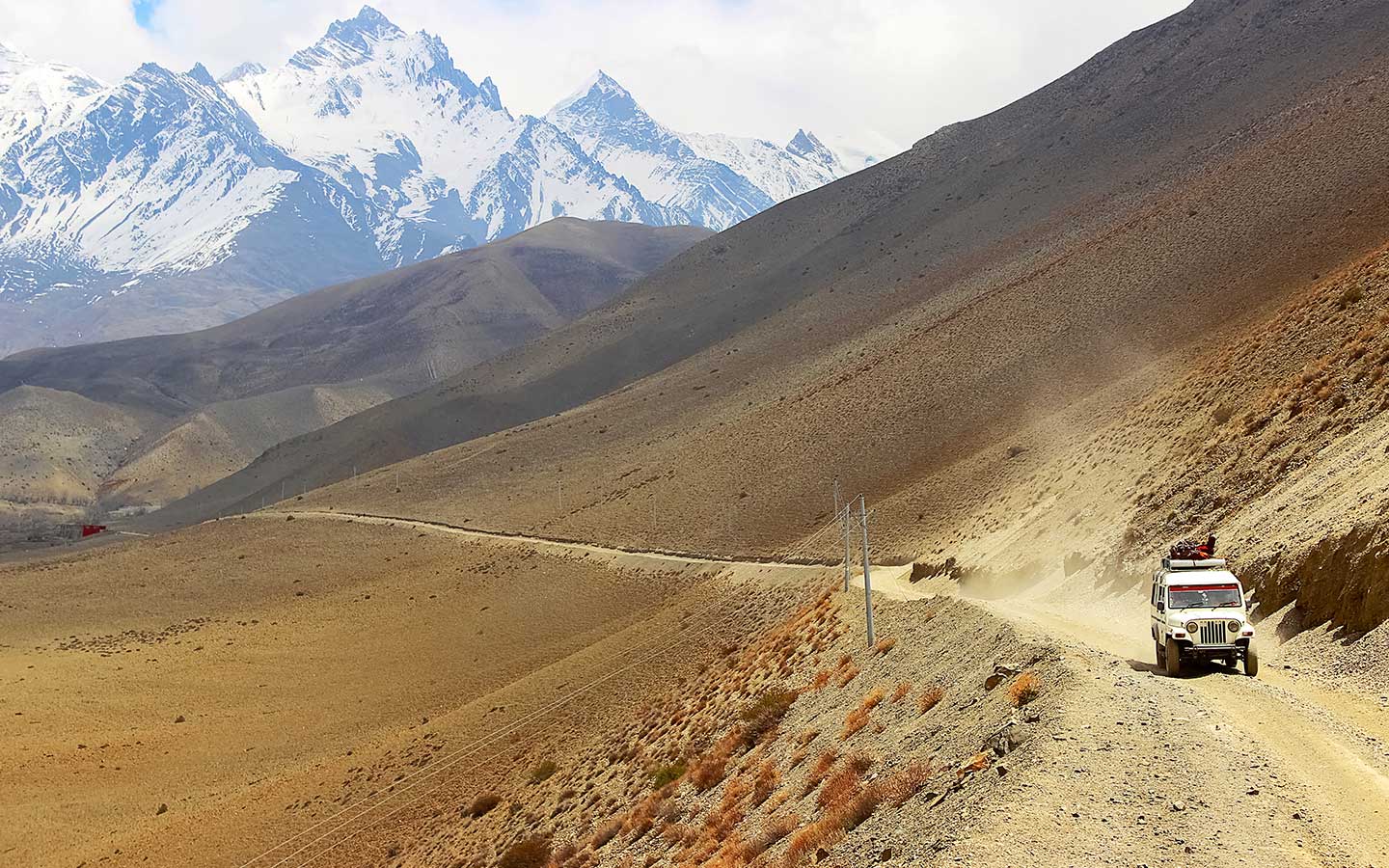
- Driving: If you are short on time, or would prefer to save your energy, you can also hire a 4WD jeep in Jomsom to take you to Lo Manthang or any other destination (some will think there is merit in spending your time in a bumpy and dusty jeep ride if the end result is seeing stunning vistas of beautiful deep valleys, colors-cliffs and windswept plateaus).
- Mixture: A lot of trekkers walk half the way to their destination, then hire a jeep for the return trip to Jomsom, saving precious time and experiencing both mediums.
Note: Flights to Jomsom have a dependency on the weather, more specifically if flying early morning, the pilot has a dependency on high winds and/or visibility conditions in the Mountains, which frequently can result in delays/cancellations.
2) Overland Route – from Pokhara to Mustang (By bus/jeep)
For those that prefer a road trip, or may want to avoid the worry of flight delays, then taking the overland route from Pokhara to Mustang via Beni is a scenic and becoming popular way of travel. An overland trip offers the chance to witness the gradual transition from lush, green hillsides to the dry highlands of Mustang; a complete change in landscape and culture.
The general route is as follows and generally will take;
Time it will take: Pokhara → Beni (approx. 3-4 hours)
Beni → Tatopani → Ghasa → Jomsom → Kagbeni → Lo Manthang (2 to 3 days depending upon your pace and time of stops).
Things to Consider During Your Journey by Road:
- Road Conditions – Some is partly blacktopped and partly rough going! There are rougher sections in between Ghasa and Kagbeni. A 4WD car is essential.
- Scenic Stops – There will be waterfalls, cliffside villages, suspension bridges, apple orchards in Marpha, and the Kali Gandaki gorge is the deepest in the world, so these are just a few places you’ll experience.
- Altitude Gain – Since the road gradually ascends, this option is better for your body to adjust to altitude than just a direct flight into Jomsom without adjustment.
Note – The overland journey is an experience in itself and gives you the feel of getting to Jomsom, but it can be tiring and dusty! Please wear a proper dust mask and have proper travel insurance.
Best Time to Visit Mustang: A Month-by-Month Insight
Mustang is among the few areas in Nepal that can be visited at any time of the year due to its special location in the rain shadow of the Himalayas. The monsoon rains that affect most of Nepal from June to August, do not reach Mustang where it stays dry, sunny and accessible.
Spring (March to May) – Colourful Landscapes, Clear Mountains
Spring is the peak season in Mustang, snow is melting, spring is warming the region, and rejuvenating life is returning to the region.
Weather: Mild Temperatures. The average day time temperatures in Lower Mustang for example it will be around 12°C to 20°C.
Scenery: In Lower Mustang the Rhododendrons start blooming and Upper Mustang sees its trails slowly reopen as the snow melts.
Trekking Conditions: The visibility conditions being good and clear skies with moderate winds took it all to an ideal situation for long treks.
Bonus: Less people than autumn, local villages will have started some agriculture, which will add another cultural experience to the trip.
Summer/Monsoon (June – August) – The Secret Monsoon Trek:
For the majority of Himalayan Nepal, monsoon means rain and rain that ruins your day, but because Mustang is in the trans-Himalayan region – it is both dry and sunny!
– Weather: generally dry and windy; daytime temperature range of about 15 to 25 degrees centigrade.
– Trekking Conditions: Although in Upper Mustang conditions are still fantastic; the trails will still be negotiable, they do not get too wet and it usually does not rain enough to create muddy conditions because of intermittent light showers.
The one unique benefit: this is the best season for trekking in Upper Mustang to suit travelers who would like to avoid busier travelled routes.
Culture Experience and Tourism: The Tiji Festival (a festival of colour and participation through a half day parade in Lo Manthang) is a highlight for culture tourism in general in May or June.
Autumn (September to November) – High season for trekking
Autumn is generally the best time overall for trekkers and others (somewhat) cultural observers to visit Mustang.
Weather: In general mild and dry, daytime temperature will sit between 10°c and 20°c (Upper Mustang), nights will be cooler by at least 5 degrees!
Views: All the beautiful mountain views, amazing golden fields, and opportunities for photos.
Trekking Conditions: Generally good weather with little chance of altitude sickness because of good acclimatization routes in Upper Mustang (more properly phased).
Disadvantage: Most popular time for trekkers, particularly in Lower Mustang, and would need to book very early for accommodation.
Winter (December-February) – Quiet but not easy
Winter brings snow and bitter cold to Mustang, particularly Upper Mustang (seasonal migrants are generally deciding to head down to lower altitudes).
Weather: Freezing temperatures, particularly in Upper Mustang (temperatures frequently at night are -10°c or below).
Access: Road may be block by snow and wind and flights could be cancel.
Trekking: Trekking is not advisable in Upper Mustang as it is difficult access, trekking Lower Mustang (Jomsom–Muktinath) could be trek if you had the right kit.
Experience: Off season is quiet with very quiet surrounding but should only be done by trekkers having experience or by adventure tourists.
Major Attractions in Mustang
1. Lo Manthang: The Walled Capital
As a significant cultural center of the former Kingdom of Mustang (and still is), Lo Manthang is the historical capital of the area. Lo Manthang is a medieval city which is walled with mud making it a living monument to Tibetan Buddhism and culture. In the narrow lanes you will also come across some interesting and ancient monasteries which include Thubchen Gompa and the Jampa Lhakhang which have ancient stories to share. They lay claim to shocked moms and the ancient art of murals and thangkas. You will also visit the Royal Palace and haven where the Mustang king use to reign, it will be a bittersweet reminder of a vibrant past and spirit of the region.

The presence of modern connections influences this medieval city though Lo Manthang has its own sense of time. Local people still wear their traditional attire and carry out their daily rituals that they witnessed as children. This quiet and ancient city catapults you back to an ancient time that has remained indifferent of modernity and reliability the relaxed feeling of positive spiritual energy, monarchy heritage and Himalayan mystical circumstances – harmoniously drawn together.
2. Chhoser Caves: Mysterious Cliff Dwellings
The awe-inspiring Chhoser Cave Complex, or the Sky Caves of Nepal, is just a short jaunt north of Lo Manthang. Archaeologists presume these cave were used for meditation, storage, burial, farm use or the permanent residence of humans thousands of years ago. The multi-chambered caves and narrow staircases provide a chilling insight of some of the ways ancient Himalayan civilizations performed spiritual tasks to sustain their existence.

As astonishing as the Chhoser Cave Complex is, it is an experience made even more spectacular in it’s size and complexity while carved into wind-shredded high desert geological area. Guides usually provide their own myths based on their ancestral stories unique to the region, and as a definitely solo traveler and hiker in Upper Mustang (kind of equally excited and terrified) you get to sense their stories too. Without question the Chhoser caves are a highlight for any hiker or history lover.
3. Kagbeni: Gateway to Upper Mustang
Kagbeni is a little village at the junction of the Kali Gandaki and Jhong rivers and the official entry point to Upper Mustang. With a dry and rugged environment of itself, there are many short-hike options that present views of the classic Nilgiri and also the well-known Dhaulagiri.

Kagbeni is not only quaint or beautiful, it also has historical and religious meaning. In addition, Kagbeni, as a stop along the salt route from Tibet through Nepal would still be a rest stop for spiritual pilgrims from all over, in paying homage along the way to Muktinath Temple.
4. Muktinath Temple: Sacred Pilgrimage Site
Muktinath is one of the holiest pilgrimage places in the world, for both Hindus and Buddhists; at an altitude of 3,800 meters, it holds an aura of liberation and spiritual purification. Hindus believe that bathing in the temple’s 108 water spouts will cleanse or purify the soul, and be completely free of all sins. The temple itself is quite simple, but the amount of spirituality described is incredibly strong. The eternal flame is of particular awe; having burned for over five hundred years.
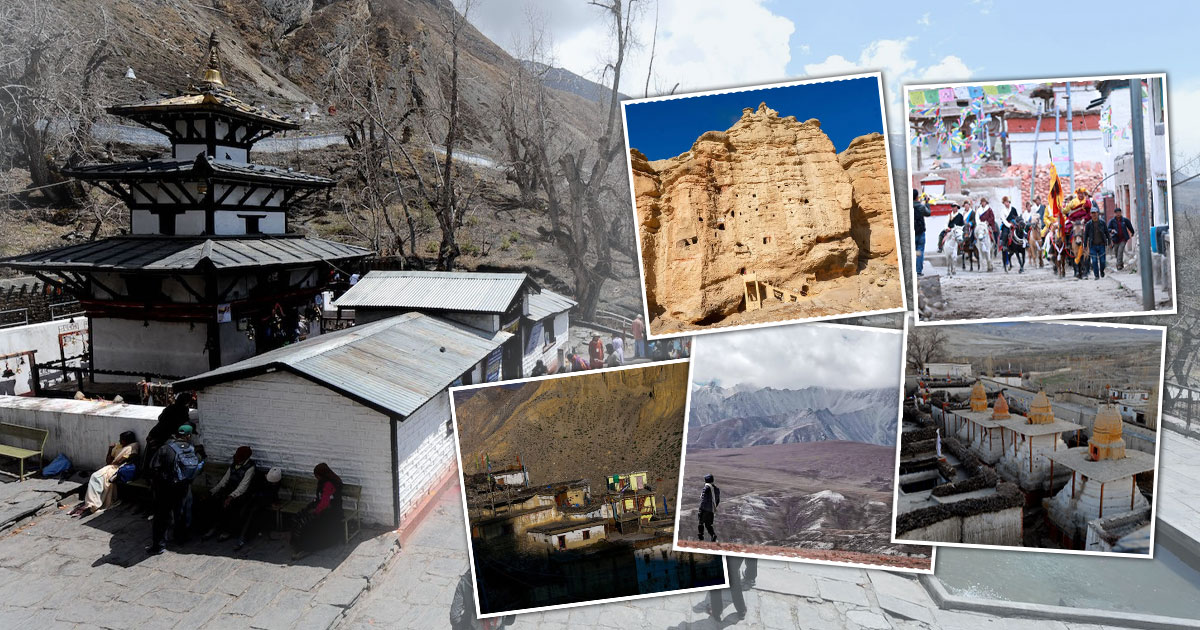
The extreme altitude and inaccessibility of Muktinath gives a dreamlike quality to the site. In this place among snow-capped peaks, with prayer flags flapping in the wind, the temple marks an important line between earth and sky. Access to Muktinath serves as a genuine adventure for pilgrims and trekkers. Visitors are just likely as lure by the beauty of the place as they are render to experience the spiritually significant. Muktinath offers a beautiful atmosphere of inviting calmness, and a sense of transcendence.
5. Tiji Festival: A Celebration of Tibetan Buddhism
For locals, experiencing Tiji in Mustang during three days of celebrations every year is not just an amazing experience – however it is – it is understanding their own deeply spiritual identity, along with their peoples’ unique spirit and tenacity! Unfortunately, going to Tiji is not like going to a Tiji festival itself, although it is similar in some aspects. Understanding Tiji is probably worth it for the experience alone. Arriving in Mustang during Tiji time is a once-in-a-lifetime experience in this world; where one of the very few places in the world continues to purport a living, Tibetan-Buddhist cultural formalism.

Tiji fosters a celebration of community, heritage and belief with a picturesque, dramatic Himalayan background while electric excitement will be felt in the atmosphere at Tiji! Dreaming of the moment of exciting, drum beats echoing the length of the city; chants by monks, and the local adorned people dancing in traditional dress – for me – Tiji is considerably enjoyable for a tourist visiting Mustang.
Why Mustang Feels Like Another World
1. Desert Meets Himalayas
The geology of Mustang was a magnificent contrast to the lush productive green hills of much of Nepal. Eventually we began to climb out of the green hills of the Kaligandaki, and an uncountable area of high desert unfolded before us. What were saw along our journey onto the Mustang were curving cliffs carved by wind, ochre-colored canyons, and dry, dusty plains. Far off where the snow-covered high peaks of Nilgiri, Dhaulagiri, and Annapurna formed a semi-staged backdrop evoking a cinematic tableau of desert meeting mountain. The raw dry landforms, and the bright blue sky bounding this unique valley made us feel as if we had just launched ourselves into the Martian landscape of another planet – and we were still in the Himalaya.
The geological landscape also contributes to the experience of travel. The trails took us past dry river beds, stone-walled villages, claw-colored cliffs with rock caves from ancient civilizations, and the natural curiosities like the Chhoser Sky Caves, and the red cliffs of Dhakumar, were entirely alien, stunning, and mysterious.

2. Tibetan Culture and Heritage
Mustang seems to be a well-preserved remnant of old Tibet. Due to its geographic proximity to the Tibetan Plateau, and continued isolation from the rest of Nepal, the inhabitants of Mustang have been able to maintain their Tibetan Buddhist cultural practices, (language, art, and rituals), for many centuries. You will see it plainly in their appropriately flat-roofed stone housing, chortens (stupas), and colourful, intricately painted monasteries. You experience it in colourful spiritual prayers from monks chanting, prayer wheels spinning, and the smell of butter lamps burning in ancient, echoing Gompas (monasteries). All together, it captures the feel and spirit of this incredible place.
You will see this cultural significance in places such to the holy Thubchen Monastery in Lo Manthang to the exhilarating Tiji Festival, and the sacred Muktinath Temple; a place where Tibetan Buddhism and Hinduism coexist in an especially harmonious union. Even smaller settlements like Tsarang, and Ghami are monumental representations rich with murals, scriptures, and heritage from centuries ago. A visit to Mustang is far greater than merely an adventure trek with interesting landscapes: it is a purposive cultural pilgrimage to place where old Tibetan traditions and hashtags, exist without exterior influences, and where they are alive and thriving.
Permits and Entry Requirements
To visit Upper Mustang, you need:
Restricted Area Permit (RAP): USD $500 for the first 10 days, USD $50 for each subsequent day
Annapurna Conservation Area Permit (ACAP): NPR 3,000
TIMS Card: Needed for most trekking. Please check what is current.
Mustang is a restricted area; you must trek with a registered guide, and have at least two travelers, not including guide/porters.
Tips for your Mustang trip

Acclimatize – while not extremely high (up to 3,800m) it is still recommended that you monitor your altitude.
Dress in layers – Mustang is windy and dry, so daytime temperatures can be warm, while at night temperatures can become cold.
Bring cash – There are very few ATMs, and only in the very bottom of Upper Mustang.
Be mindful of the local population – ask permission before you take photos of people, observe modesty standards for clothing, and learn the basic etiquette around Buddhism in monasteries.
Travel sustainably – Mustang is fragile in terms of the environment. Try to limit your plastic waste, and support local/regional businesses.
Conclusion: Why You Should Explore Mustang Now
Mustang, a place of myth, history, and wilderness. There, surreal landscapes and unspoiled Tibetan culture mix with profound spirituality. It will almost certainly change with modernization in Nepal, so travel now while you can still see this nearly-hidden expression of the Himalayas. If you are planning to visit Nepal then contact us today at Happy Mountain Nepal, Facebook, Instagram, or TikTok.


